
Wheeler County Genealogy
Wheeler County lies in the dry hills of north-central Oregon, where the John Day River carves through painted rock and fossil beds. Genealogy research here draws from ranch records, land files, and vital documents kept at the county seat in Fossil. Searching Wheeler County archives connects you to the ranching families and stage line pioneers who built this remote area. Records go back to 1899, when the county formed, and they hold key details for anyone tracing roots in this part of the state.
Wheeler County History and Origins
Wheeler County was named for Henry H. Wheeler. He was a pioneer who ran a stage line through the region. The county formed in 1899, carved from parts of Crook, Grant, and Gilliam counties. The county seat was set in Fossil, a small town on the banks of the John Day River. From the start, ranching drove the local economy. Cattle and sheep spread across the hills, and the ranchers who ran them became the core of Wheeler County life.
The town of Fossil got its name from the ancient fossils found in the area. The John Day Fossil Beds, now a national monument, sit partly in Wheeler County. While the fossil beds draw tourists today, in the early years they were just part of the landscape that ranchers and their families knew well. For genealogy, this setting matters. Wheeler County was remote and hard to reach. Families who settled here tended to stay for a long time. That means Wheeler County records often show multiple generations of the same family living on the same land.
Because Wheeler County is young by Oregon standards, its record set is smaller than those of coastal or valley counties. But what it lacks in depth it makes up for in focus. Nearly every record from the early years ties to a ranch, a school, or a small town. This tight focus makes Wheeler County genealogy work more direct than in larger, more complex counties.
Wheeler County Clerk Records
The Wheeler County Clerk in Fossil holds marriage files, deed books, and lien records from 1899 forward. These are the base of all Wheeler County genealogy research. The clerk logs every land sale, marriage, and court filing. In a small county like Wheeler, the clerk's records cover nearly every family that lived here.
Deed books are a top source for Wheeler County genealogy. Ranch land sales, homestead entries, and brand registrations all appear in these books. Each entry lists the buyer, the seller, the date, and the tract. Livestock brand books are another key source. Brands were registered with the county, and the brand book lists the owner's name and the mark they used on their stock. A brand record proves that a person ran cattle or sheep in Wheeler County at a known date. Under ORS Chapter 192, most Wheeler County records are public and open for review.
Marriage records from Wheeler County are also at the clerk's office. In a small county, marriages were community events. The marriage file lists the names of both parties, their ages, and the date. Some files also name parents or witnesses. These details are useful for building a Wheeler County family tree and linking one generation to the next.
Note: Wheeler County is one of the least populated counties in Oregon, so the clerk's office in Fossil may have limited hours; call ahead to plan your visit.
Wheeler County Ranch Genealogy
Ranching was the backbone of Wheeler County. The hills and valleys along the John Day River provided grass for cattle and sheep. Families built ranches that lasted for generations. The records they left behind are a strong tool for genealogy work in Wheeler County.
Property tax rolls from the county assessor list each ranch owner and the value of their land and stock. These rolls are kept year by year. You can track a family through Wheeler County just by following the tax rolls. When a name drops off the roll, it may mean a sale, a death, or a move. Each event leads to a different record type for more detail. Water rights filings show who drew from the John Day River and its creeks. In this dry part of Oregon, water was life. Disputes over water often ended up in court, and the case files hold names, dates, and sworn statements.
Homestead records from the federal government also tie into Wheeler County ranching history. Many ranches started as homestead claims filed under federal law. The National Archives holds these files. Each file includes the filer's name, the date, and a description of the land. A homestead file can prove that your ancestor was in Wheeler County at a set time and place.
Wheeler County at State Archives
The Oregon State Archives in Salem holds Wheeler County records on microfilm. Circuit Court files, probate estate files, and school records are in the collection. The date range runs from 1899 forward. If you cannot get to Fossil, the State Archives is the next best place to search for Wheeler County genealogy records.
Probate files from Wheeler County are very useful. They list heirs, describe ranch land, and may include inventories of livestock, tools, and household items. In a ranching county like Wheeler, a probate file can paint a full picture of how a family lived. The files are indexed and on microfilm at the State Archives. You can view them in the research room or order copies by mail.
School records are another valuable source. Wheeler County had small rural schools scattered across the landscape. Each school kept a log of students, their ages, and their parents' names. These records place a family at a specific spot in Wheeler County at a known time. Under ORS 192, these public records are open for review at the State Archives.
This image shows the State Archives page for Wheeler County. It lists the record types and date ranges held, which helps you plan your Wheeler County genealogy research.
Oregon Archives and Wheeler County
The Oregon State Archives is the main hub for county records across the state. For Wheeler County researchers, it is often the most practical way to access old records without a long trip to Fossil. The archives hold records from all thirty-six Oregon counties, and their staff can help you find what you need.
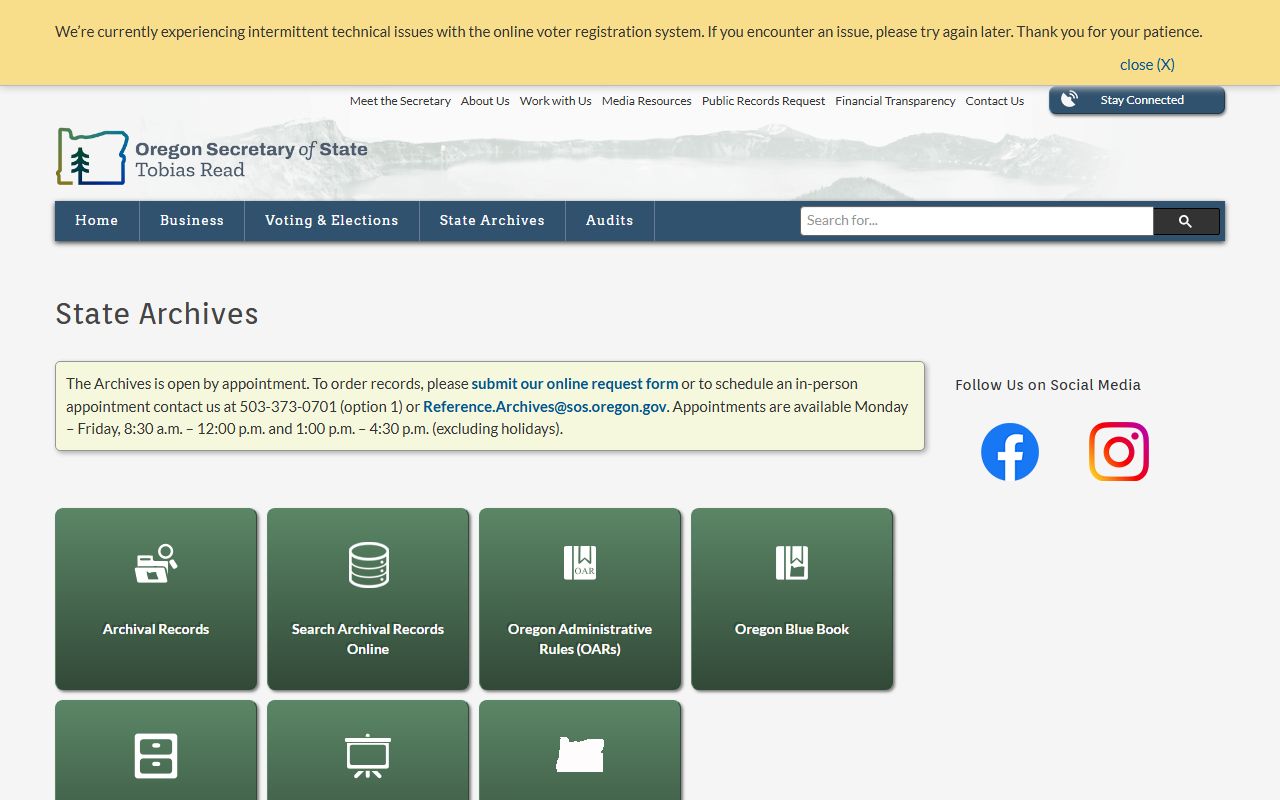
The image above shows the Oregon State Archives main page. It is the central resource for county records across Oregon, including Wheeler County genealogy files. From this site, you can search the catalog, learn about visiting hours, and find contact details for the research staff.
Beyond court and probate files, the State Archives also holds maps, survey records, and voter registrations that tie into Wheeler County genealogy. Voter rolls from the early 1900s list the names and addresses of Wheeler County residents. These can help you confirm that an ancestor lived in the county at a given time. Survey records show how the land was divided, which is helpful when you try to locate a ranch or homestead on a modern map.
Note: The Oregon State Archives research room is in Salem and is open on weekdays; check the website for current hours before you visit.
Wheeler County Community Records
Fossil, Mitchell, and Spray are the main towns in Wheeler County. Each is small. Each has its own place in local history. Church logs, school files, and newspaper records from these towns hold names and dates that official county records may not show.
The Fossil Journal newspaper covered Wheeler County for decades. Its pages hold birth notes, death reports, marriage news, and legal filings. Old issues are on microfilm at the State Archives. A single mention in the Fossil Journal can confirm a date or a family link that you cannot prove from any other source. Newspapers are one of the best tools for Wheeler County genealogy work because they capture the daily life of a small community in a way that official records do not.
Cemetery records also help. Small cemeteries near Fossil, Mitchell, and Spray have burial logs that list names and dates. Some have been transcribed by local groups and posted online. Walking through a Wheeler County cemetery can give you a feel for the families who built this area and the ties between them. Under ORS 192, public cemetery records must be open for review. Private cemetery records depend on the owner.
Tips for Wheeler County Research
Start with what you know. Write down every name, date, and place.
Key resources for Wheeler County genealogy include:
- Wheeler County Clerk in Fossil for deed and marriage records
- Oregon State Archives for probate and court files
- National Archives for homestead and census records
- Local newspapers on microfilm for community details
- Cemetery transcriptions posted online by genealogy groups
Online tools can help you plan your research before you travel. The State Archives has an online catalog that lists Wheeler County holdings. Census records from 1900 through 1950 are online at various genealogy sites. Local groups may have indexed Wheeler County records and shared them on the web. Because Wheeler County is small and remote, any advance work you do online will save you time and effort once you get to Fossil or Salem. Under ORS 192.495, a fair fee may apply for copies from the clerk or the State Archives.
Nearby Counties
Wheeler County borders Gilliam County, Grant County, Crook County, Jefferson County, Wasco County, Sherman County, and Morrow County. If your ancestors lived near the county line, records may be filed in a neighboring county.